Percept, Affect and Concept

‘What is preserved – the thing or the work of art – is a bloc of sensations, that is to say, a compound of percepts and affects.
Percepts are no longer perceptions; they are independent of a state of those who experience them. Affects are no longer feelings or affections; they go beyond the strenghth of those who undergo them. Sensations, percepts and affects are beings whose validity lies in themselves and exceeds any lived. The could be said to exist in the absence of man because man, as het is caught in stone, on the canvas or by word, is himself a compound of percepts end affects.
The work of art is a being of sensation and nothing else: it exists in itself.’

‘Composition, composition is the sole definition of art. Composition is aesthetic and what is not composed i snot a work of art. However, technical composition, the wprk of the material that often calls on science (mathematics, physics, chemistry, anatomy) is not to be confused with aesthetic composition, which is the work of sensation. Only the latter fully deserves the name composition and a work of art.’

‘There is only a singular plane in the sense that art includes no other plane than that of aesthetic composition: in fact, th etechnical plane is necessarily covered up or absorbed by the aesthetic plane of composition. ‘

‘What defines thought in its three great forms – art, science and philosophy – is always confronting chaos, laying out a plane over chaos. But philosophy want to save th einfinte by giving it consistency: it lays out a plane of immanence that, through the action of conceptual personae, tales events or consistent concepts to infinity. Science, on the other hand, relinquishes the infinite in order to gain reference: it lays out a plane of simply undefined coordinates that each time, through the the action of partial observers, defines states of affairs, functions or referential propositions.’

‘The three thoughts intersect and intertwine but without synthesis or identification. With its concepts philosophy brings forth events. Art erects monuments with its sensations. Science constructs states of affairs with its functions. ‘

Gilles Deleuze and Félix Guattari: What is phylosophy?
Translated by Hugh Tomlinson and Graham Burchell

pre-colonial

“My work isn’t anti-colonial or post-colonial. It’s pre-colonial. I want to remember who we were two thousand years ago. Not just before slavery, but before the idea of empire. That’s why I say my work is about beauty, not politics.”

Qudus Onikeku in City magazine

hoogmoed

In een discussie tussen Franciscaner minderbroeders over de misdragingen van paus Johannes XXII, in Umberto Eco’s ‘De Naam Van De Roos’, vraagt een deelnemer ‘Waarom toch?’ en antwoord William ‘Ik geloof niet dat er een reden voor is. Het is een proeve die hij zich veroorlooft, een daad van hoogmoed. Hij wil werkelijk degene zijn die voor de hemel en de aarde beslist.’
Ik dacht meteen aan Trump. Rationele verklaringen zijn niet toepasbaar voor zijn gedrag.

alledaagse waanzin

Het lezen in ‘De naam van de roos’ van Eco herinnert me eraan dat Amerikaanse complotdenkers christenen zijn. Door waanzin bevangen en hun eigen gezonde verstand overschreeuwend met vuiligheid die hen opwindt

onaangenaam

We leven in een tamelijk onaangename wereld, waarin niet alleen de mensen, maar ook de gevestigde machten er belang bij hebben ons droeve affecten over te brengen.

Gilles Deleuze in gesprek met Claire Parnet, 1977 (vertaald door Monique Scheepers in 1991)

living

“Contrary to a fully established discourse, there is no need to uphold man in order to resist. What resistance extracts from this revered old man, as Nietzsche put it, is the forces of a life that is larger, more active, more alternative and richer in possibilities. The superman has never meant anything but that: it is in man himself that we must liberate life, since man himself is a form of imprisonment for man. Life becomes resistance to power when power takes life as its object. Here again, the two operations belong to the same horizon (we can see this clearly in the question of abortion, when the most reactionary powers invoke a ‘right to live’). When power becomes bio-power, resistance becomes the power of life, a vital power that cannot be confined within species, environment or the paths of a particular diagram. Is not the force that comes from outside a certain idea of life, a certain vitalism, in which Foucault’s thought culminates? Is not life this capacity to resist force? From The Birth of the Clinic on, Foucault admired Bichat for having invented a new vitalism by defining life as the set of those functions which resist death? And for Foucault as much as Nietzsche, it is in man himself that we must look for the set of forces and functions which resist the death of man. Spinoza said that there was no telling what the human body might achieve, once freed from human discipline. To which Foucault replies that there is no telling what man might achieve ‘as a living being’, as the set of forces that resist.”

Deleuze: Foucault

FUNGI. Anarchistische ontwerpers in Nieuwe Instituut Rotterdam

30 jaar na Mycelium in Landbouwbelang Maastricht beginnen het rizoom en schimmels eindelijk de aandacht te krijgen die ze verdienen. Schimmels zijn een zeer oude, grote en belangrijke levensvorm op de planeet waarop wij wonen. Voor de filosofen Deleuze & Guattari diende het rizoom ook als basis voor hun concept voor alternatieve en meer vruchtbare denkwijzen. De expositie Funghi in het Nieuwe Instituut vraagt opnieuw aandacht voor de alomtegenwoordige schimmels. We leven intens en intiem met hen samen en verontachtzamen hen evenzeer.

(afbeelding: eigen werk, 2025)

IFFR 2026

Met leuk campagnebeeld en het programma belooft boeiend te worden.

Ckeck it out on iffr.com

Lass uns Freunde bleiben

Dit soort cafés maakt Berlijn geweldig. Waar in Amsterdam de horeca bestaat uit nietszeggende gelegenheden met smakeloze interieurs vindt men in Berlijn nog authentieke ruimtes. Voor mensen in plaats van consumensen.

Beuys actueel

Deze installatie in het Hamburger Bahnhof is plots helemaal actueel en een inspiratie voor (jonge) mensen vandaag. Beuys hield bijeenkomsten met onder andere kunststudenten en maakte daarbij aantekeningen op schoolborden die vervolgens gefixeerd werden.

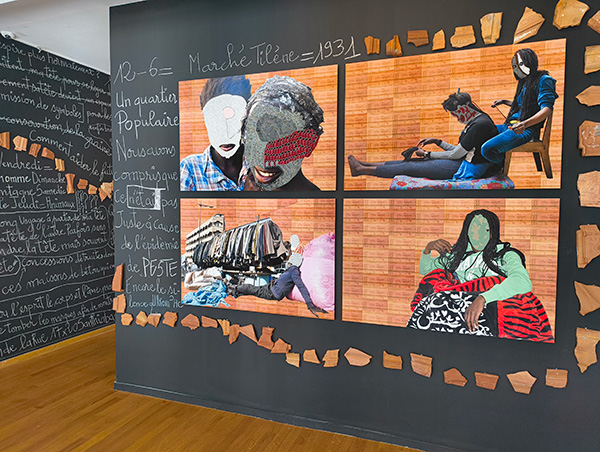
Tegelijkertijd is even verderop bij KW een expositie met actuele politieke kunst waar vooral ook werk van buiten de eurocentrische bubbel te zien was.

kunst is geen vermaak

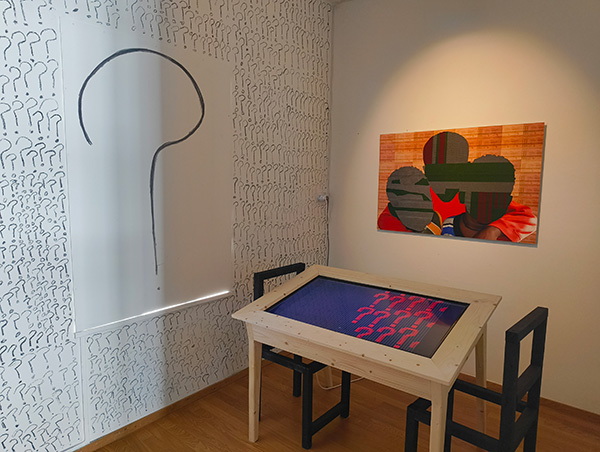
Kunst hoort raadselachtig en vreemd te zijn.
Je hoeft niet te weten wat je ziet.

Bedacht ik tijdens het lezen over musea en vermaak in De Witte Raaf. En ook tijdens het invullen van een enquête na een bezoek aan de Fiona Tan expo in het Rijksmuseum waarin gevraagd werd of ik mij vermaakt had. Hoezo vermaakt??

Baroque

‘The Baroque artists know well that hallucination does not feign presence, but that precense is hallucinatory.’
Deleuze, The Fold p.125

body

‘The soul and the body can always be truly distinguished, but inseparability traces a coming and going between one level and the other. My unique monad has a body; the part of this body have crowds of monads; each of this monad has a body …’
Deleuze, The Fold p. 108

monad

‘We have seen that the world was an infinity of conversing series, capable of being extended into each other, around unique points. Thus every individual, every individual monad expresses the same world in its totality although it only clearly expresses a part of this world, a series or even a finite sequence.
Deleuze, The Fold p. 60

Scroll to Top